
Notice

Due to the ongoing situation with COVID-19(Coronavirus), the events originally scheduled for 2022 may be postponed or cancelled.
Please check the original website before you actually schedule them.

Enjoy Hiroshima's traditional art form, Kagura, in the middle of Hiroshima City

You are lucky if you are in Hiroshima on Wednesday night.

It is because you can see Kagura, one of Hiroshima's representative Traditional Performing Arts, in the downtown area of Hiroshima City.

But what is Kagura then? Click here (Kagura Monzen Touji Village)


Originally, Kagura was performed at local shrines after rice planting or harvesting, but now it is performed once a week on Wednesday nights in the center of Hiroshima City so that people who come from all over the world can see this enjoyable traditional performance.


Hiroshima Kagura, like a play, is made up of a story.

For example, in the play "Yamata no Orochi," which is known by most people in Hiroshima, the god Susanoo-no-mikoto defeats a giant snake and saves an elderly couple whose daughters are swallowed by the snake every year.
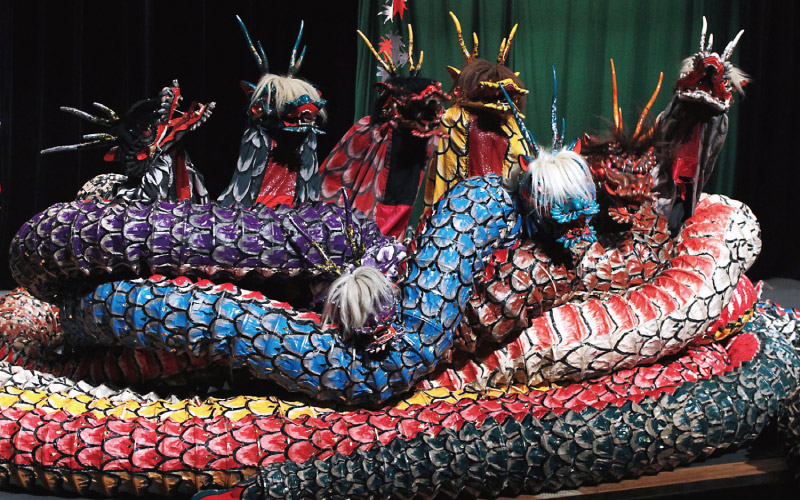
©Hiroshima Prefectural Citizens' Culture Center

Even if you don't understand the words, you will be able to recognize the gods, demons, samurai, etc. by the facial expressions on the masks, and that will help you understand the story.
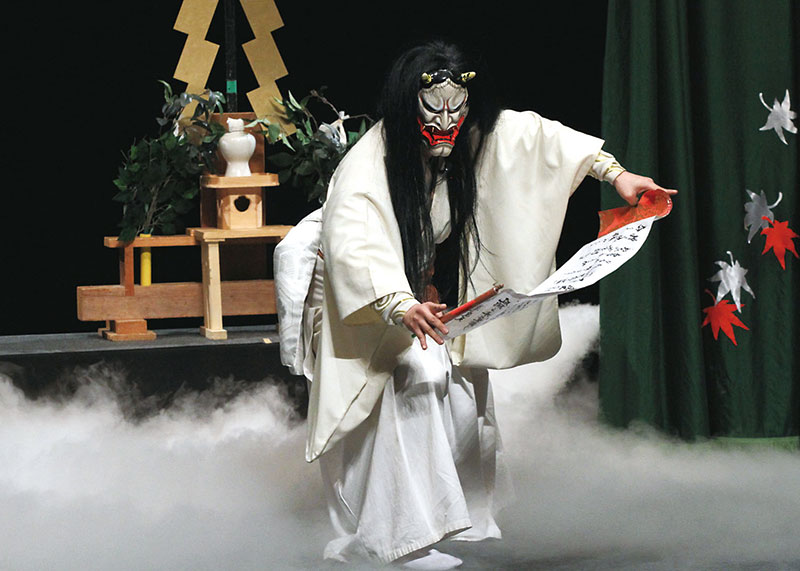
©Hiroshima Prefectural Citizens' Culture Center

Before each performance, a summary of the story is handed out in English so that everyone can understand and enjoy the story.

You can also check it here.

The lively rhythm, the climax of the dance and its power of the music, the dazzling costumes, and the quick mask that is changed before you know it; these are the works done by non-professionals.

In many areas of Hiroshima, volunteers have formed Kagura troupes and are practicing daily, and they perform in Hiroshima City on even weeknights for many people to see.

Video recording is not allowed, but you can take pictures of them.
Take some Instagrammable pics and please share them on the SNS!


How to buy tickets

Please refer to here.


Venue

Hiroshima Prefectural Citizens' Culture Center

Comments

Popular Posts

KONISHI KOI FARM

How deeply Hiroshima is related to carp, or koi, can be seen in the name of its professional baseball team, Hiroshima Toyo Carp, the carp castle, the alias of Hiroshima Castle, and the fact that there is a town named Koi (the large residential area in Hiroshima City) .  Hiroshima has long been known as one of the two major Nishikigoi (the carp that have colors and patches and are raised as ornamental fish )- producing areas in Japan. One Koi farmer has a history that dates back even more than a century ago. Konishi Koi Farm is the world’s oldest Nishikigoi breeding farm.  In recent years, its name has been found in a German guidebook "REISE-KNOW-HOW" as well as in JAPAN HOUSE in Sao Paulo, established as a Japanese national project.  Konishi Koi Farm has also donated the Nishikigoi swimming gracefully around in the moats of Hiroshima Castle or in the pond in Shukkeien Garden, a traditional Japanese garden in the city. Not only do they have a long history, but ...

A sea route that connects two UNESCO world heritage sites in Hiroshima

There are two world famous UNESCO world heritage sites in Hiroshima, “Atomic Bomb Dome” and “Itsukushima shrine”. As for the transportation, there is a “World Heritage Sea Route” that directly connects these two world heritage sites, besides railways (Streetcar and/or JR train) and Ferry combination; what’s more, it takes only 45 minutes, the fastest way to go back and forth between these two locations. As one of the busiest areas in Hiroshima, there used to stand variety of markets and inns in a row around Peace Memorial Park. You can see its remnant of old days by seeing the stairs down to the river. It is called “Gangi”, and was used for loading/ unloading stuff in and from boats carried along the river. Enjoy a short trip to Miyajima, finding different side of the history in Hiroshima. For further information including the fare and the timetable: http://www.aqua-net-h.co.jp/en/heritage/ Motoyasu Pier Miyajima 3rd Pier

A way to enjoy another face of Miyajma; "Nana-ura Meguri", a tour to visit seven shrines along Miyajima by a private yacht

Speaking of Miyajima, most of you would imagine O-torii gate in Itsukushima shrine. It is about only 1 km from Miyajima Port, the entrance of the island, to Itsukushima Shrine on Miyajima Island, but the island’s outer circumference is about 30 km. It may be bigger than you can imagine. The town area in Miyajima you see may be full of people. Then, what's in the rest of the area in the island where many tourists don't go? Itsukushima Shrine is a place where God is enshrined. It is said that the god enshrined now searched around the island to find a good place to build a shrine before deciding the location of the current Itsukushima shrine. People gradually started to go around the island and visit the shrines in the seven ura (coves), just as following the action this god took. This is the origin of " Nana-ura Meguri " meaning visiting seven coves. By the way, if you try to complete " Nana-ura Meguri " - visiting all seven shrines-, you have to approach fro...